Category Archives: Uncategorized

Domestic Violence and Child Custody: A 4-Part Model for Helping Judges Make More Informed Decisions


Family Court judges should consider the impact of violence on families when making decisions about child custody
and visitation, according to Kristine Lizdas, a managing attorney at the Battered Women’s Justice Project. In this podcast, Lizdas discusses the
Justice Project’s four-part model for helping judges make more informed decisions.
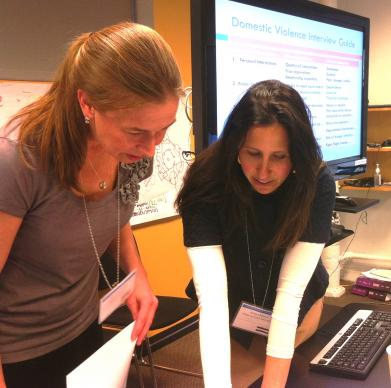
Kristine Lizdas, left, of the Battered Women's Justice Project and Robyn Mazur of the Center for
        Court Innovation confer after Lizdas' presentation at the Center's Domestic Violence Court Open
        House for Office on Violence Against Women Court Training and Improvements Project grantees.Kristine
Lizdas, left, of the Battered Women’s Justice Project and Robyn Mazur of the Center for Court Innovation confer
after Lizdas’ presentation at the Center’s Domestic Violence Court Open House for Office on Violence Against
Women Court Training and Improvements Project grantees.

KRISTINE LIZDAS: 
[While introductory theme music plays] This person, the person they’re abusing, could be bringing a great deal,
could be wonderful caretakers for their kids, and could be providing so much for their kids, if it were not for the
battering.

ROBERT V. WOLF:  [As introductory theme music ends] Hi, I’m Rob Wolf,
director of communications at the Center for Court Innovation.  Welcome to another New Thinking podcast.
Today I’m speaking with attorney Kristine Lizdas about domestic violence cases and their impact on child custody
and visitation. Christine serves as managing attorney for the Legal Policy Program of the Battered Women’s Justice
Project, which is a national resource center on domestic violence legal policy issues. Welcome to New York and the
Center for Court Innovation.

LIZDAS:  Thank you very much.

WOLF: 
You’re based in Minnesota, but you’re here today at our open house. The Center for Court Innovation serves
as the Office on Violence Against Women’s comprehensive technical assistance provider for its courts program, and
today and tomorrow, recipients of grants have come here with their multi-disciplinary teams to observe model domestic
violence courts in New York, and hear from experts like you on topics related to planning and implementation of domestic
violence courts. So I know you’re here today speaking to the group this afternoon about custody and visitation,
and I thought a good way to start our conversation was just to ask what makes custody and visitation cases that involve
domestic violence a challenge, or more complicated than the average case?

LIZDAS:  We
have, in the battered women’s movement, done a lot of work in terms of reforming the criminal justice system
so it handles the crime of domestic violence better, as a crime, as a wrongdoing of the violation of a right. Talking
about domestic violence in the context of family court is more complicated.

The way family court
is structured and set up is not conducive, does not allow for an assessment of how domestic violence operates—meaning
how is it used in the family, and to what effect? And what impact does it have on the parenting capacities of both
parents? What impact is it having on the kids?  Family court is designed to kind of divvy things up. 
Family court is not designed to say, “This is our situation. How do we kind of move forward from here, given who’s
involved in this family and what the family’s history is?”

WOLF:  Maybe you can
just offer an example of how that can impact a particular family.

LIZDAS: In families where domestic
violence exists, or domestic violence is alleged, there can be violence that has been very isolated, that the children
have been very sheltered from it, but there are going to be other situations in battering violence and coercive and
controlling violence where the kids are brought in more deliberately, either because they’re being exposed to
the continuum of violence going on in that family, or because they are being used to either participate in the abuse
of their spouse, or the same sort of demeaning or controlling, or crazy-making behaviors that a batterer might perpetrate
in a domestic violence situation, is being perpetrated against the family as a whole. 

The
kids are going to have a variety of reactions—everything from no reaction at all, to feeling very aggressive toward
the abused parent, feeling very protective of the abused parent.  It’s going to manifest in problems,
you know cognitive and behavioral issues that come up for the kids, and until we really have a handle or understanding
on really what’s happening to the kids, we don’t know what kind of separation agreements, what kind of
parenting schedule, what type of supervision, or what types of programming or services are appropriate for that family.

WOLF:  How are you recommending that family courts address that issue, because it does sound like
it’s very complicated?

LIZDAS:  We engaged in this project several years ago to
develop a framework for family court practitioners so that they can better identify, they can better understand,
and then account for the context and the implications of domestic violence in child custody cases, and in parenting
time and visitation determinations. 

At this stage of our project, we are recommending
a four-part analysis, which is very simply that we need to institute tools into various parts of our family court
systems that help us to better identify the existence of domestic violence, whether alleged or not, that we have
implemented protocols within the family court system and help us better understand the nature and the context of
the violence. Who’s using the violence to what end? What impact is it having on the family? 

And
then the hardest part, the third step of this four part framework. is then to determine the implications of abuse
and research is emerging on how to recognize that, how to screen for it, how to identify it. If kids are having trouble
with sleeplessness or trouble with school, or are showing strong attachments to either parent, to understand which
of those behaviors, which of those responses are a response of the coercive and controlling violence, what might
be the response of other things going on with that family. 

And finally, the fourth step
in our framework is then, indeed, to account for the abuse in our decisions in court and in what we do in the parenting
plans going forward.  It would be our proposition that if you have identified actual coercive and controlling
violence or battering violence in a family, it’s very likely that some of that coercive and controlling violence
is going to continue post-separation, that the dissolution and the parenting plan doesn’t put a stop to it. 

Some judges, some court practitioners do see that perpetrators will be motivated by their kids, and access
to their kids. So family court judges and family courts have this opportunity, and the proper motivation, to get
perpetrators into services and into programs, to keep an eye on that perpetrator—to be like a mentor, to be a coach,
to be a motivator to keep that perpetrator from using coercive and controlling violence, and they can order graduated
visitation, graduated parenting time.

WOLF:  So the judges can use this leverage—access
to the children, basically: “You can get thus and such visitation under these conditions if you receive these services,
if you engage in this particular program?”

LIZDAS:  Yes, and it’s not only that it is
an effective motivator for change, but its also completely logically tied to what is best for the children. We do
want children to be able to have healthy relationships with both parents and it’s in the children’s best interest
if we are able to figure out how to work with the perpetrator over time and help them develop their parenting capacity. 
I think it’s been the observation of a lot of people who work with parent batterers that they really aren’t aware
of how their battering and coercive and controlling violence affects their kids. And in the current court system,
we provide motivations for parents to attack each other. We put them in this sort of adversarial system that encourages
them to sort of undermine each other’s parenting capacity, and we don’t have enough of a mindset or framework in
family court to say that what we need to be doing, really, is supporting each other’s parenting capacity and if you’re
violent toward your partner, if you’re committing coercive and controlling violence, you know, you’re taking
something away from your kids and we need to be drawing that connection, obviously.

WOLF: 
That point you just made, that was a much broader point about any family court case involving custody or visitation.

LIZDAS:  It is, that’s true, and it would apply in cases that we technically, or traditionally
call high-conflict cases, which is jargon in the family court system, which is applied very broadly to any parties
that don’t seem to be able to settle on their own, or fail in alternative-dispute resolution.  So that is
a message for high-conflict parents that you need to understand better how your conflict is impacting your kids. 

In battering situations, or course, or controlling situations, where we really want to focus is on the person
perpetrating the violence—make sure they understand how this person, the person they’re abusing could be bringing
a great deal, could be wonderful caretakers for their kids, could be providing so much for their kids if it were
not for the battering.  What’s concerning is the family court system that doesn’t have a sophisticated analysis
is going to look at battering cases and they are going to call it high conflict—and then they’re targeting and directing
their messaging to both parties, and their messaging’s not really the appropriate messaging either. It’s “Get along.” 
It’s “Get along or you’re going to hurt your kids.” That’s not the message that’s appropriate if one person is using
coercive and controlling violence against the other.

WOLF:  So if people want to find
out more about these issues or some of the skills that you’re developing, what should they do? 

LIZDAS:  They should contact our office, the Battered Women’s Justice Project.  Our website
is www.bwjp.org, and our toll-free telephone number is 1-800-903-0111,
enter prompt 1 to get to our office where the custody project is based.

WOLF:  I’ve
been talking with Kristine Lizdas about domestic violence cases and their impact on child custody and visitation. 
Kristine is the managing attorney for the Legal Policy Program of the Battered Women’s Justice Project. Good luck
with your presentation this afternoon.

LIZDAS:  Thank you very much.

WOLF: 
[While theme music plays] I’m Rob Wolf, director for communications at the Center for Court Innovation. 
To listen to this podcast or others, you can visit our website at www.courtinnovation.org
 or subscribe to our podcast on iTunes. Thanks for listening.

June 2013


After Rockefeller: Research Findings on the Statewide Impact of Judicial Diversion


Shannon M. Carey
of NPC Research discusses
the impact of the Rockefeller Drug Law Reform, which in 2009 eliminated New York’s mandatory prison sentences
for most felony drug offenders. According to a study she co-authored, court-ordered treatment enrollment after the reform
was implemented in 2009 increased by 77 percent. Also, the study estimated that there would be a potential $2 of
newly available resources after five years for every taxpayer dollar invested.

May 2013


ROB WOLF: Hi, I’m Rob Wolf, director of communications at the Center for Court Innovation.
Today I’m with Dr. Shannon Kerry, and executive vice president and senior research associate at MPC Research,
which is based in Portland, Oregon. Today we’re talking about a study. The proper name of the study is 
Testing
the Cost Savings of the Judicial Diversion Program
. And if I understand correctly, what this
study is looking at is the impact that that passing of the Rockefeller Drug Law reforms in April 2009 had on judicial
diversion. In other words, drug addicted offenders who were going through court. How many were now being diverted
to alternatives to incarceration. So I thought maybe we could begin with the parts of the study which really looked
at the impact on treatment and on sentencing outcomes.

DR. SHANNON KERRY: Sure. So
the first question that we looked at was, as you said the impact on treatment and what we found was quite a bit of
an impact. There was a 77 percent increase in enrollment into treatment programs, and so people are being diverted
into treatment instead of being incarcerated. The actual numbers went from 1,801 participants in the one year before
to 3,192 people in the one year after October 7th, when it was implemented. So that’s, again, a 77 percent increase
in enrollment in treatment.

ROB WOLF: And that’s statewide in all of New York?

DR. SHANNON KERRY: That’s all the state, right.

ROB WOLF: So 77 percent increase.
So it really, by giving the judge’s discretion, which is essentially what the law did—freed them up from a mandatory
jail sentence, many of them took advantage of that, clearly.

DR. SHANNON KERRY: Right. And it
did vary by geographic location. So some places increased up to 500 percent, and in other places there wasn’t
much difference.

ROB WOLF: The other issue was—

DR. SHANNON KERRY: The second
question was what kind of sentences to people receive for the same charges? So Article 216 is the name of the actual
legislation. And people who are eligible for Article 216, we wanted to see what their sentences were before and after
it was actually implemented. Before the implementation, 100 percent of the people who had an Article 216 eligible
charge were convicted. Afterwards, it was about 81 percent of the people. So 19 or almost 20 percent of the people
after Article 216 had their cases dismissed. So if they successfully completed the program, they never had a conviction.
As far as sentencing outcomes, we found that people spent less time in jail and less time on probation, and about
the same time in prison. And then community supervision was also lower after implementation.

ROB
WOLF: Well let’s move on to the cost benefit part of the study. What costs were you looking at, and what benefits
were you actually measuring?

DR. SHANNON KERRY: The first question we looked at was what was the
cost of a judicial diversion case in itself before the new law was implemented and after. What we found was the cost
of judicial diversion, including the program with treatment, was about $18,500. The cost of the case that was eligible
for judicial diversion, but before judicial diversion, the actual cost of processing that case was about $13,000.
So it was fairly expensive per offender to process them anyway. And the difference in cost was about $5000, a little
bit more than $5,000 per offender. So judicial diversion does cost more, and the majority of that additional cost
is due to treatment.

ROB WOLF: I see. And so the $13,000, before the law was passed involved all
the sort of non-treatment aspects that take place in a case before someone’s going to jail. Before the actual
sentence is implemented?

DR. SHANNON KERRY: Right. So then the next question we asked was about
the sentence for that judicial diversion eligible case, so what we’re calling the instant case. So what kind
of sentence did people get before, and what kind of sentence did they get after? So earlier we talked about the finding
we had about the sentencing practices is that people after judicial diversion spent less time in jail and less time
on probation, and about the same amount of time in prison. So that translates into cost if they spent less time in
jail and less time on probation, then they’re going to cost less. With prison being basically a wash, there
wasn’t a big difference between them, there was a total savings due to judicial diversion of about $5,500 per
offender.

ROB WOLF: So in that case, you’re simply comparing the amount of time spent in
jail, prison, or probation for both these groups?

DR. SHANNON KERRY: Correct.

ROB
WOLF: And so this is where you saw some savings, because there was less time spent in prison and on probation for
those involved in judicial diversion after the implementation of the law?

DR. SHANNON KERRY: Right.
So those people who were spending less time in jail were spending a lot more time in treatment. So that treatment
cost we talked about earlier, $5,000, is kind of made up for by them not spending the time in jail.

ROB
WOLF: So what else did you look at?

DR. SHANNON KERRY: The other thing that we wanted to look
at was the impact of being in judicial diversion on their future criminal behavior. So did they get rearrested less
often because they went through treatment or not? Because Article 216 wasn’t implemented until 2010, October
2010 we didn’t have enough time to look to see if people who were literally sent through the new judicial diversion
had lower recidivism outcomes. When we were doing the study it was 2012. Most of the people were still in the program.
So what we did was we took another study that CCI is just in the midst of completing, and they looked at people who
went through drug court and people who didn’t, and they selected out the people who had Article 216 crimes.
And then they compared the comparison group to people who went through drug court for a three year period, looked
at their recidivism outcomes. And then we put costs to those recidivism outcomes. What we found was over three years,
the cost of someone who went through judicial diversion was just under $20,000, so $19,000. The cost of their time
in jail, prison, their court cases, their new rearrests. Altogether over three years came to just under $20,000,
$19,589 specifically. While the cost in the comparison group, people who were eligible for judicial diversion that
didn’t go was $25,787, so almost $26,000 which results in a savings of just over $6,000 per offender. We then
extrapolated over a five year period. It comes to about $11,000 per participant, a benefit of $11,000 per participant.
And then if you include victimization costs, which anybody who committed a person crime or property crime, there’s
a victim involved. So when we included the victimization costs as well, it comes to just over $18,000 saved, per
offender, for that time period.

ROB WOLF: And what is that associated with? The victimization
cost? That’s actually the value of the stolen goods?

DR. SHANNON KERRY: It’s a whole
combination of when there’s a victim involved there’s often, you know, injuries and the property, and the
damage, fixing the damage. It’s all those things combined.

ROB WOLF: But it doesn’t
include things like pain and suffering? It just includes the tangible injury? Like if someone was injured, it’s
the medical costs. Is it also their lost wages?

DR. SHANNON KERRY: Yes. And we pull those from
a national study of victimization, so those are ones that were calculated specifically for New York.

ROB
WOLF: And when you look at benefits, do you also calculate things like someone is now re-employed, and therefore
contributing taxes to the economy, and that sort of thing?

DR. SHANNON KERRY: We do include that
when we can, but for this study we were looking specifically at taxpayer savings due to criminal justice costs. So
they didn’t include the employment costs.

ROB WOLF: So overall what was your finding? There’s
clearly the money that goes into any case involving judicial diversion, but then there’s also money saved. So
when you compare those two, what’s the overall conclusion?

DR. SHANNON KERRY: Well what we
found is that as far as investment goes, there’s kind of a net investment of just over $5,000 per offender.
And then if you look at the people afterwards, their recidivism, we found that there’s a net savings of about
$10,000, a little over $10,000 per offender. So basically the net benefit is a little over $5,000, which is a cost
benefit of 1:2. So for every dollar you spend investing in the program, you get $2 back.

ROB WOLF:
That sounds like a substantial, or meaningful, at least, return on an investment.

DR. SHANNON
KERRY: It is pretty good.

ROB WOLF: Well I want to thank you very much for taking the time to
explain your work on this study which is an impressive piece of work. People can download it from our website, and
from MPC Research website, which is—Shannon, if you don’t mind telling me?

DR. SHANNON KERRY:
It’s www.mpcresearch.com.

ROB WOLF: Great, well I’ve been speaking with Dr. Shannon
Kerry, and executive vice president and senior research associate at MPC Research based in Portland,
Oregon. We’ve been talking about the recent study that she was involved with along with the team here at the
Center for Court Innovation that looked at the Cost Savings of the Judicial Diversion Program, here in New York,
after the passing of the Rockefeller Drug Law reforms. I’m Rob Wolf, director of communications at the Center
for Court Innovation. You can download this and other podcasts at our website, www.courtinnovation.org and also on
iTunes. Thanks for listening.


Welcome to Problem Solving: Kelly O’Neill Levy Embraces Her New Assignment as Presiding Judge of the Harlem Community Justice Center


Acting Supreme Court Judge Kelly O’Neill Levy discusses her transition from Bronx Family Court to the Harlem
Community Justice Center
, where she applies problem-solving strategies to both family and housing cases. May
2013

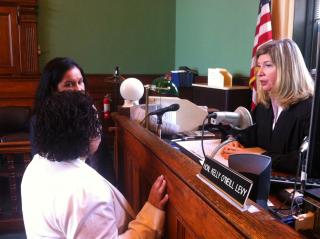
Judge Kelly O'Neill Levy discusses a case with her law clerk and resource coordinator.Judge Kelly O’Neill Levy discusses a case with her law clerk and resource
coordinator.


JUDGE KELLY O’NEILL
LEVY: Always remember that the person who is before you—that the problem they’re coming to court with could
be the most important problem they have in their lives.

ROB WOLF: Hi, I’m Rob Wolf, director
of communications at the Center for Court Innovation. Welcome to another New Thinking podcast. Today I’m in
the Harlem community Justice Center with acting Supreme Court Judge Kelly O’Neill Levy, who came to the justice
center in January of 2013, just a few months ago, from the Bronx Family Court, where she was handling child abuse
and neglect cases. I thought we’d sit down and talk a little bit about the transition to her new position and
her vision for the work that she’ll be doing here, and has been doing here the last few months. So welcome to
New Thinking.

JUDGE KELLY O’NEILL LEVY: Thank you, Rob. It’s a pleasure to be able to sit
down and talk with you about the Harlem Community Justice Center.

ROB WOLF: Transitions sometimes
pose challenges as well as opportunities, and I was wondering what you’ve seen so far as far as your challenges
and opportunities as you’ve made the transition from a more conventional New York City family court to a community
court setting, where you’re hearing both family and housing cases, as well as interacting more with the community.

JUDGE KELLY O’NEILL LEVY: There have been challenges as far as getting up to speed. We’ve worked really
hard to get up to speed, but many of the issues that are facing the litigants that we have in Bronx Family Court,
or the issues that are underlying people’s concerns here in housing court are the same. And what is wonderful
about what we are doing here is often you hear when you’re listening to a litigant, other problems—unrelated
necessarily—to non-payment. And the beauty of the Harlem Community Justice Center is we have resources right here.
We have people to assist these litigants in the underlying problems, whether it’s mental health, whether it’s
adult protective services.

ROB WOLF: So it sounds like it’s a more holistic approach.

JUDGE KELLY O’NEILL LEVY: Yes. It’s the holistic approach and we’re thinking of all different
ways that we can be serving this community in our court. One of the things that we are going to be launching in the
next few months—custody and visitation cases that will originate in the Harlem Community Justice Center. Litigants
will have an opportunity to choose whether they want to commence a case for custody and visitation in our case, or
go downtown and commence the case in the downtown family court. I’m also going to be doing Article 78 cases,
which are appeals for an administrative body. So if somebody has an appeal based on a decision that the New York
City Housing Authority has done, they have, in the past, had to go to Supreme Court and do an Article 78 case based
on an administrative decision that has taken place in, for instance, a NYCHA case. Now if I am the judge who’s
handling the landlord-tenant case, I will also be handling the administrative appeal. And that also is a holistic
approach because unfortunately what has happened in the past is sometimes the Supreme Court judge was unaware of
what was going on in the landlord-tenant case, and the person could have possibly gotten a victory in Supreme Court
but by the time that case was heard, they may have already been evicted because that judge was unaware of the status
of exactly where the landlord-tenant case was at that time.

ROB WOLF: So it sounds like there
are a lot of advantages to brining the cases here to the Harlem Community Justice Center. It’s local for the
litigant. They don’t have to travel as far. It’s more comprehensive because you have a fuller understanding
of all the aspects of the case, and there’s also services here like the housing resource center that can support
litigant and landlords as well.

JUDGE KELLY O’NEILL LEVY: We’re very fortunate, because we
have this resource center right in the building. So both tenants and landlords can go to the resource center and
get assistance on how to navigate the process, which can be very intimidating, as we all know.

ROB
WOLF: So let’s talk about community engagement. That’s a guiding principal of a community court like the
Harlem Community Justice Center. Why do you think community engagement is important, and how is the justice center
giving you opportunities to work more closely with the community?

JUDGE KELLY O’NEILL LEVY: It’s
essential that we have community engagement because we are here to serve the community and it’s given us many
opportunities. We have the resource community in the courtroom. She is able to reach out to the service providers
that are in the area that are assisting our litigants to see what they need and how we can assist them better. We
also have a church that’s right across the street that is hosting programs for our reentry program, which assists
people formally incarcerated to get back into society.

ROB WOLF: We’ve talked a lot about
your housing cases, but I know you also handle family court cases. Maybe you could tell me a little bit about what
those case are and how the Harlem Community Justice Center does things maybe a little differently?

JUDGE
KELLY O’NEILL LEVY: We handle juvenile delinquency cases and custody and visitation cases. The things that we do
differently is that the custody and visitation cases, there’s mediation to help parents work out the conflicts
that they’re having. And with regard to the juvenile delinquency cases, we have the services here in order for
these families to be able to work through the juvenile delinquency justice process. Each child, they are living at
home and they meet with the social worker in the court to assist them in making the changes they need to make in
order to ensure that they don’t have any re-arrests in the future. Do they need drug treatment program? Do they
need counseling? And one of the things we just started, somewhat based on the work that I had done in Bronx family
court, is to recognize that the parents play such a critical role in making sure that the child is able to make those
changes. So we’ve started a parent support group. Some of the parents have been able to really turn things around,
assist in transferring their children’s school, helping to enforce curfew, and what we wanted to do was have
those parents be able to assist the other parents who may be having struggles with getting their child to adhere
to a curfew, or navigating the process of transferring them to a different school. The other component to the parenting
group is just an education of what the whole juvenile delinquency justice system is about, and what they can expect.
And we think that this is really a helpful new component that we’ve implemented in the Harlem Community Justice
Center.

ROB WOLF: You’ve had a chance to learn about the community so I wonder what have
you learned and seen so far?

JUDGE KELLY O’NEILL LEVY: Well this has traditionally been an underserved
community and one of the things that is great about this court is that the size is less intimidating for people than
a traditional court. We are on a much smaller scale because there is only one courtroom, there is only one judge,
and that gives us an opportunity to do exciting things which can, we hope, build confidence in the justice system.
One of the things that we are doing is we are translating pre-printed stipulations of settlement and right now many
attorneys come to court with pre-printed stipulations of settlement that they, then, negotiate with tenants and insert
the applicable numbers and time frames that a tenant would have to comply with in order to resolve their case. And
there are many Spanish-speaking litigants who would not have the benefit of leaving the courthouse with a document
that they could truly understand. And so what we have started is a process of getting the pre-printed stipulations
of settlement translated into Spanish. Of course the document that I would review and sign would all be in English,
but the Spanish speaking litigant would have a reference when they left in Spanish. And I think that that alone would
be one step in assisting public confidence in our justice system.

ROB WOLF: That translated stipulation,
other judges could use around the city because it’s a uniform language, I assume?

JUDGE KELLY
O’NEILL LEVY: Yes, certainly. If some of the larger firms who may practice in other boroughs in the city, they certainly
could use that translated stipulated if they find that they’re having that same issue.

ROB
WOLF: So do you have a philosophy of judicial leadership? I know you’ve only been here a few months so far,
but what does it mean to you to be a community court judge?

JUDGE KELLY O’NEILL LEVY: If I had
any philosophy of judicial leadership, it would be to always remember that the person who is before you—that the
problem they’re coming to court with could be the most important problem they have in their lives. And to always
make sure that they feel that they’ve had an opportunity to be heard, and that they’ve had a fair adjudication
of their case. And so one of the things I really enjoy about being a community court judge is that I am able to give
people that opportunity to be heard, and I am able to consider whatever their issues are, and really try to solve
their problems.

ROB WOLF: Well I want to thank you very much for sharing some of your experience
with our listeners. I’ve been speaking with acting Supreme Court Judge Kelly O’Neill Levy, about her experience
here as presiding judge over the family and housing cases at the Harlem Community Justice Center.

JUDGE
KELLY O’NEILL LEVY: Thank you, Robert, it’s been my pleasure.

ROB WOLF: I’m Rob Wolf,
director of communications at the Center for Court Innovation. To listen to this podcast and others, visit our website
at www.courtinnovation.org or iTunes. Thanks very much for listening.


Studying Reentry: A Conversation about Research and Reentry Courts


Christine H. Lindquist, a senior research sociologist at RTI
International
, talks about reentry
courts, recidivism, and what she’s learned so far from a multi-year study funded by the US Department of Justice. April 2013


CHRISTINE LINDQUIST: Reentry courts really have a talent in terms of delivering all of the needed services
to a diverse population.

ROBERT V. WOLF: I’m Rob Wolf, director of communications at the
Center for Court Innovation, and on this New Thinking podcast we’re talking about reentry courts with Christine
Lindquist, a Senior Research Sociologist at RTI International. She just completed the first phase of a multi-year
study of eight reentry courts around the U.S. Welcome to New Thinking, Christine.

LINDQUIST: Thank
you so much for having me.

WOLF: We should be clear about what we mean by the word reentry. So
what is reentry referring to?

LINDQUIST: Reentry refers to the process of a person leaving prison
after incarceration and reintegrating back into their community.

WOLF: You worked on an earlier
evaluation. So I thought maybe we could start off, if you talk a little bit about some of its highlights and how
they may have prepared you for this one.

LINDQUIST: Sure. So the multi-side evaluation of the
Serious and Violent Offender Reentry Initiative, or SVORI, which is a little easier to say, was a large multi-year
evaluation and we looked at recidivism and other outcomes for individuals who received enhanced reentry programming
through SVORI, as well as a comparison group of returning prisoners who received treatment as usual. And basically
in the SVORI evaluation, when we looked at short term effect. And by short term effects we mean recidivism within
two years and then other outcomes such as drug use, employment that we looked at during shorter periods, such as
three months after release, nine months and 15 months. We found some short term effects when looking at some outcomes.
So, for example, for some employment outcomes, people who received enhanced reentry programming did better than those
who received treatment as usual. However, when looking at recidivism, we didn’t really find strong short term
effects. But interestingly, when we looked at longer term recidivism through another grant that we received, we did
find positive effect for recidivism, and by this we mean reductions in arrest, a longer average time to first arrest
following release, and longer time between arrests for the SVORI group compared to those who received treatment as
usual. So I think one thing we learned from the SVORI evaluation is that recidivism effects took longer to observe,
and that suggests the need for longer follow-up in evaluations in order to detect those. And then also we found that
it’s really important not to just assume that all services are helpful. Some services may be more effective
for certain types of prisoners than others. For men, we found that services that promoted individual change – such
as anger management programs, or programs that help with personal relationships, or criminal thinking, were associated
with longer times to first arrest following release. For women, having a case manager and receiving life skills training
were associated with reductions in recidivism. So it just appears that there’s a lot more to be learned about
the effects of different services and that they may be different for men and women.

WOLF: That’s
very interesting. Let’s move on to your current evaluation that you are working on. Now this study focuses on
a particular model called the reentry court. So maybe you could take a moment just to talk about what a reentry court
is?

LINDQUIST: Sure. Reentry court grew out of a larger national movement towards problem solving
courts. And problem solving courts and the drug court model is the most common and well known of these programs,
are courts that combine judicial authority with rehabilitative services. The reentry courts are specialized problem
solving courts specifically focused on recidivism. So they combine judicial oversight, which includes court hearings
in which a returning prisoner would have his or her status reviewed on a regular basis, and if they’re doing
well they would receive praise or other types of rewards, such as advancing through the program. If they’re
not doing well, they would receive graduated sanctions. So it combines this judicial oversight with the provision
of enhanced reentry services.

WOLF: So in the case of a drug court, the ultimate graduated sanction,
if you take it all the way to end would be a jail sentence. In the reentry model, people have already served their
time. So what is, in fact, the leverage that the court has?

LINDQUIST: In almost all of the sites
that are participating in this evaluation, reentry court is established as a condition of supervision. So if someone
isn’t doing well in the reentry court, if they’re not doing what’s expected of them, then the leverage
that the court has is that their supervision would be revoked.

WOLF: And then return to prison,
in other words, because there’s still time on their formal sentence?

LINDQUIST: That’s
right. They could be returned to prison.

WOLF: Well let’s talk about the current study you’re
working on. It’s a collaboration among researchers at your organization, RTI International, which is based in
North Carolina, and NPC Research, which is based in Oregon, and the Center for Court Innovation here in New York.
It’s the first in a series of evaluation that are going to look at what particular aspects of reentry courts?

LINDQUIST: Yeah, it’s actually a single evaluation, but it’s a multi-component evaluation that
includes a process study, an impact study, and a cost effectiveness study. So in the process evaluation, we’re
documenting the start up and ongoing implementation of the eight reentry courts included in the study over several
years in time, looking at what the implementation challenges were, what the context in which the courts are operating
is, what some of the interagency partnerships look like. And then also, as part of our process evaluation, we want
to see what some of the common elements are among the eight programs, to try to see if we can develop a true reentry
court model similar to what we have for drug courts, you know, with the 10 key components. And then for the impact
evaluation, we’re looking at how effective these reentry courts are at reducing recidivism and affecting other
important outcomes. In all eight of the sites, we’re planning on using administrative data to look at rearrests
and reincarceration outcomes, using a masked comparison group design. And then in four of the eight sites, we’re
doing a prospective impact study where we’re interviewing clients who enroll in the reentry court program, and
we’re also interviewing a comparison group of comparable individuals returning from incarceration. And that
allows us to measure employment, family re-integration, community involvement, mental health, substance abuse. And
then we’ll also be able to document personal characteristics that maybe associated with program effects, such
as readiness for change, risk, need for services, and other measures like that. And then finally, we have a cost-effectiveness
analysis where we’re going to be documenting what the costs are of implementing a reentry court, and then also
looking at what the overall cost savings is, if any. So those are the three components of our evaluation, and the
report that we just released is the summary of our first year’s work in the process evaluation.

WOLF:
Given these, that you have eight sites and so many different factors, I mean it seems to me that that’s very
challenging and I wonder if you could talk about some of the challenges of making sense from so much information—eight
different sites, so many different variables.

LINDQUIST: Yeah, the variability is actually not
a problem for the process evaluation. It actually makes it more interesting because we’re really characterizing
how the courts fall on a variety of domains. It’s really interesting to highlight the sources of variability
as opposed to the sources of commonality. What is challenging, though, is for the impact evaluation because when
you have a diverse set of programs, it’s very difficult and often times it’s impossible to pool the data
across the sites. When there’s too much variability, we’re forced to look at site-specific impacts, which
means that effects on recidivism would have to be very large for us to be able to detect those using analytic techniques.

WOLF: What are the most significant findings so far?

LINDQUIST: Well, at this stage I
don’t think we can identify any promising practices or evidence-based practices that seem to be associated with
program effectiveness. What we know so far is that reentry courts are very diverse, unlike drug courts which target
a specific population—people with chemical dependencies. Reentry courts don’t typically target a population
with a specific need, and as a result, reentry courts really have a challenge in terms of delivering all of the needed
services to this diverse population. Another interesting finding, I think, is that you know when reentry courts were
initially conceptualized they were really conceptualized to have a heavy pre-release and post-release component,
such that ideally the person would be identified at the time they were initially sentenced, and that the reentry
court would maintain contact with that person throughout their incarceration. But what’s interesting is that
there really isn’t a major emphasis on pre-release services. A lot of courts don’t have the capacity to
reach in and work with clients while they’re incarcerated. Someone could get sent to prison three hours and
some reentry courts aren’t even sure who is actually going to be coming out on conditional release.

WOLF: You know I’ve really enjoyed hearing about the study and I look forward to seeing it progress.

LINDQUIST: Well thank you. I really enjoyed speaking about our study. We’re excited about our initial
findings and look forward to getting further into this evaluation.

WOLF: Well let me let everyone
know that they can download a copy of the year one study, that’s formal name is the “National Institute
of Justice’s Evaluation of Second Chance Act Adult Reentry Courts – Program Characteristics and Preliminary
Themes from Year One.” And they can download it from our website at www.courtinnovation.org. I’m Rob Wolf,
director of communications at the Center for Court Innovation, and I’ve been speaking with Christine Lindquist,
a Senior Research Sociologist at RTI International. Thank you, everybody, for listening.


Changes ‘That Don’t Roll Back’: Using Technology to Institutionalize Innovation


Kevin G. Kelly, deputy commissioner of NYC Business Customer Service in the New York City Mayor’s Office,
discusses how the city uses technology to improve efficiency and radically restructure how businesses interact with
government. January 2013


KEVIN
KELLY: Create a new operating normal so that there is no other way to do it. And that’s really the way to use
powerful levers like technology to make changes that don’t roll back.

ROB WOLF: I’m Rob Wolf, director of communication at the Center for Court Innovation. With
me today is Aubrey Fox, the Center for Court Innovation’s director of strategic planning. Today we’re looking
at how technology can be used to improve government and institutionalize innovation. Helping us explore these issues
is Kevin G. Kelly, deputy commissioner of NYC Business Customer Service in the New York City Mayor’s Office. Thanks
for hosting us in your office today.

KEVIN
KELLY: My pleasure.

ROB WOLF:
You’ve been working at the intersection of technology and government for a number of years, particularly helping
change the way businesses interact with city agencies. How important has technology been to that effort and what
have you been able to achieve?

KEVIN
KELLY: Well technology has been a fundamental building blocking driving innovation and radically restructuring how
businesses interact with the city. And if you find a process that’s in a manual state, or that’s paper-based,
or that requires people to go from their place of business to a city location in order to fill out a form and pay
a fee with a money order, bringing technology to bear so that they can enter their information remotely, pay for
things online with a credit card, and manage their transactions with the city using technology has really enabled
us to take what had been a series of fragmented and paper-based processes, and bring them into the 21st century.

AUBREY FOX: Can you give us some concrete examples of
where technology has changed how a customer interacts, or how a citizen interacts with the city?

KEVIN KELLY: So prior to the city building a website
called NYC Business Express, there were no licenses or permits or certifications that businesses required online.
In all cases, those papers needed to either be mailed in or brought into a physical location, so on NYC Business
Express, there’s now 57 licenses, permits, and certifications that a business can go online, create a very simple
account, select the licenses and permits that they need for their business type, pay with a credit card, and send
all of the data to a city agency for processing.

AUBREY FOX: And I can imagine that the opportunities to use technology to improve these processes
are endless. How do you choose what you focus on?

KEVIN KELLY: That’s a great question. So start at one end of the spectrum, which is sort of
Nirvana. If you had $10 billion in 10 years, you could replace every existing legacy system and mainframe, and then
think about practical elements. The amount of money that’s available, how much time the disruption to business
is, etc. The best possible solutions are ones that allow us to leave, to the extent possible, systems that are fundamentally
sound in place so that from a customer perspective, things are radically transformed. They can do things over the
web, they can access the Internet, they can create an account, they can transact with the city. They don’t know
what’s going on behind the curtain. And what’s behind the curtain is sort of an aggregation of technology
solutions leveraging, to the extent possible, the good and the sound and the viable that’s there, with targeted,
specific system switch-outs in cases where it was impossible to mold or extract value out of something that was already
in place.

AUBREY FOX: I think
it’s important to say that you’re using technology to try to meet a policy goal, which is to increase access
to business activity.

KEVIN KELLY:
The other component piece that I would add is that when you make it so difficult to understand what it is that you’re
supposed to do in order to be in compliance. There are businesses that will move forward with their business plan
anyway and they are, you know, just sort of taking a chance that they’re not gonna get caught. So wrapped up
in the economic development objective is also increasing compliance, and increasing the quality of compliance that
business have with oversight agencies like the fire department, and the department of buildings, and the health department.

AUBREY FOX: Does your department have the freedom to
choose where you go? I mean can you survey a city business and say, now I want to look at problem x, now I want to
look at problem y?

KEVIN KELLY:
We have a tremendous amount of latitude inside of some fairly well understood parameters. So for NYC business customer
service, anything that touches on city and, in certain cases, other government oversight requests and demands on
the part of businesses are part of what we’re focusing on and working on. So it could be regulatory analysis,
taking a look at all those laws and requirements associated with licenses and permits and thinking about ways to
simplify the “what” of it. It could be operational transformation, which is the “how” of it.
How you change the way in which things get done. It could be learning and planning, instructional, or producing videos
that are designed to show businesses elements of oversight requirement that potentially would require 15 pages of
text, but if you show someone in a video what you’re talking about, it can be 30 seconds, or two minutes, or
two and a half minutes.

ROB WOLF:
So are there issues around the mayor’s achieved certain fundamental shifts and changes, and you want to embed
those changes in this technology? I mean is that part of it as well?

KEVIN KELLY: It’s not so much embedding the changes in the technology. It’s using the
technology to create a new operating normal so that there is no other way to do it. And that’s really the way
to use powerful levers like technology to make changes that don’t roll back. Because the easy changes are policy
changes. “I hereby declare that…”, you know, or executive orders or, you know, things that happen at
50,000 feet—change with administrations, change with different commissioners, etc. But when you operate at the operational
and technological level, and you change the way things were done and create the way things are done, and you make
it impossible for things to be done in the way that they were, then you’ve effectively guarded against roll
back. And the only thing that you need to concern yourself with when you’re integrating technology into operational
processes is to remember that not everyone can access the Internet. Not everyone is comfortable accessing the Internet.
Some people need support. Some people have language barriers, some people have other types of disabilities. So you
transform your current customer service locations or processing centers that are seeing lots of over the counter
traffic from everyone, because everyone has to do it this way. Those locations should be for the people who need
help.

ROB WOLF: It’s hard
for me to visualize a policy change at the 50,000 feet that you described, that then surfaces in a drop-down menu
on an online questionnaire or something. Can you give an example of how you would take something that—

KEVIN KELLY: Sure, lots of examples. So if an administration
or legislative body decides that people who are looking for certain types of social service should not have to go
through intake 15 times, right? So you can have a policy that says data sharing among social service agencies will
be utilized in order to reduce the number of times someone has to fill out duplicate forms. Then what that can translate
into is a website that has a uniform sort of data capture front end, right? A form that has the three fields that
everyone uses— name, address, phone number, email address, social security number, etc. And then, and on the back
end, that same data packet could be sent to multiple agencies to process someone for specific services, but it doesn’t
mean that that person has to over, and over, and over supply the same information.

AUBREY FOX: Creating a new normal. That seems like the power of technology
at its best. Would you say that’s correct?

KEVIN KELLY: Yes. Technology is without a doubt the single most powerful tool that can be used in
a service delivery realm to create a new operating normal. But in and of itself, it doesn’t necessarily do the
trick. So the business process re-engineering has to happen. You have to analyze what the oversight or policy objectives
are, and I think sometimes where folks get in trouble—not just in government, in private sector it happens all the
time as well—is when they think of technology as an end rather than a means, and they become enamored of a technology
for itself, as if in and of itself it was something that was worthy of admiration, or worthy of consideration.

ROB WOLF: We’ve been talking with Kevin G. Kelly,
who is the deputy commissioner of NYC Business Customer Service in the New York City Mayor’s Office. Thanks so much,
Kevin, for taking the time to talk to us.

KEVIN
KELLY: It was my pleasure. Thanks very much for your interest.

ROB WOLF: If people want to just get a sense of some of the innovations we’re talking about,
is there a web address they can go to to learn more?

KEVIN KELLY: Sure. So one would be www.nyc.gov/businessexpress, and you can look at the one stop
tool that we’ve built for businesses to make it easier to start to operate and expand in the city. Another website
would be www.nyc.gov/nbat, which is the website for the city’s new business acceleration team that works with
food service establishments in a quicker, more efficient manner.

ROB WOLF: That’s great, well thank you very much. I’m Rob Wolf, director of communication
at the Center for Court Innovation, and I’ve been here with—

AUBREY FOX: Aubrey Fox, the director of strategic planning.

ROB WOLF: And to find out more about Center for Court Innovation or to
listen to our podcasts, you can go to our website at www.courtinnovation.org. You can also download our podcasts
on iTunes. Thank you very much for listening.


Testing a Public Health Approach to Gun Violence: A conversation on new research


Authors of new research about gun
violence
in Brooklyn, New York, Sarah Picard-Fritsche and Lenore Cerniglia discuss findings on
Save Our Streets (SOS) Crown Heights, an approach to gun violence prevention in the Crown Heights neighborhood. The
new report, “Testing
a Public Health Approach to Gun Violence
,” details a comprehensive impact and process evaluation of Save
Our Streets, which is based on the Cure Violence model that treats outbreaks of violence like epidemics of disease.

Additional Resources

To download a Q &
A with the authors, click here.

To read a press release about the findings, click
here.

SARAH SCHWEIG: Hi, I’m Sarah Schweig
of the Center for Court Innovation, and today I’m speaking with Sarah Picard-Fritsche and Lenore Cerniglia,
authors of new research about gun violence in Brooklyn, New York, and an approach to preventing it in the Crown Heights
neighborhood. The new report, Testing a Public Health Approach to Gun Violence, details a comprehensive impact and
process evaluation of Save Our Streets Crown Heights, a program started in 2010. Save Our Streets is based on the
Cure Violence model which treats outbreaks of violence like epidemics of disease, taking a public health approach
similar to campaigns that have addressed risky behaviors such as smoking or not wearing seat belts. Thanks for speaking
with me today and welcome. The Save Our Streets Crown Heights approach to stopping gun violence, known as the Cure
Violence model, uses violence interrupters to prevent shootings before they happen. Can you speak a bit about the
origins of the model and who these violence interrupters are, what their background is, and what violence interruption
actually looks like in practice.

SARAH PICARD-FRITSCHE: The origins of the SOS model, the Save
Our Streets model, it comes from Chicago. The first program of this type began in 1999 and it was designed by a public
health scholar named Dr. Gary Slutkin, and essentially violence interrupters are just a piece of a multi-part model,
but the violence interrupter’s job is to go into a community where they are familiar with those folks who are
at high risk of becoming perpetrators or victims of gun violence and work directly with those folks to try to come
up with—to mediate the conflict and come up with alternatives to gun violence as a solution to the conflict.

SARAH SCHWEIG: Great, and where do they generally come from? How do they have that kind of expertise?

SARAH PICARD-FRITSCHE: Well they’re considered, under the model, credible messengers. Essentially because
they have a background that is either, they were gang involved or possibly perpetrators or victims of some kind of
violence, if not gun violence in the past. Usually they’re from the target community but if they’re not,
they are currently living in or are familiar with the target community. So that means that they, and so they’ve also
sort of turned their lives around so they are able to talk with the folks that are currently involved in the violence
about how to change. So they go out into the community, they find the folk that they knew before they turned their
lives around, start talking to them, find out what the current conflicts are, go find the people that are involved
in the conflicts, and try to work with them directly.

SARAH SCHWEIG: because this approach is
about prevention, I would imagine that evaluation is kind of tricky in that you’re trying to kind of gauge the
amount of violence that was prevented by this approach. So what was your methodology like for this research and how
did you get the numbers that suggest to you that Save Our Streets Crown Heights is really working?

SARAH
PICARD-FRITSCHE: Well it is difficult to evaluate. I’m going to let Lenore speak about the impact evaluation,
which is how we measure the reduction in gun violence in Crown Heights.

LENORE CERNIGLIA: So first
of all, we used quasi-experimental design where we took the shooting numbers from the NYPD for fatal and non-fatal
shootings for the Crown Heights precinct as well as adjacent precincts to Crown Heights that had similar demographics
and crime numbers. And we took those numbers in addition to the shooting numbers from Brooklyn as a whole from a
period of approximately 17 months prior to the start of SOS as well as 21 months following its implementation, to
see if there are any changes as well as the trends that were going on. So our idea was, if we can look at what’s
going on in beforehand, as well as these similarly matched areas in Brooklyn as a whole, then we can see once Crown
Heights has been going on for some times if these changes are also either reflected in these similar areas, or if
crime was displaced from Crown Heights into these adjacent precincts.

SARAH SCHWEIG: Testing a
Public Health Approach to Gun Violence gives the numbers that the average monthly shooting rates in Crown Heights
decreased by 6 percent. In surrounding areas, shooting rates increased by 18-28 percent, and that suggests that gun
violence in Crown Heights is about 20 percent lower than it would have been without Save Our Streets. Did the report
considers whether violence was forced out of Crown Heights into the surrounding areas like you said, the displacement
of violence?

LENORE CERNIGLIA: Yes, and we were able to test that by looking at the shooting numbers
from Brooklyn as a whole, from the whole borough, and we found that the whole borough was going up at the same rates
as these surroundings precincts as well, so Crown Heights was kind of that jewel that was actually decreasing while
surrounding precincts, and the entire borough were increasing at much higher rates. 

SARAH SCHWEIG: Right, places far away from Crown Heights.
So the report also shows that over 100 potentially deadly conflicts were mediated by violence interrupters since
2010 and that violence interrupters mediated conflicts involving more than 1,300 people. It also showed that Save
Our Streets increases residents’ confidence in the power of community to prevent gun violence. Why is the confidence
of the residents so important in violence prevention?

SARAH PICARD-FRITSCHE: We have previous
research which essentially shows that community level values and community confidence in the ability of their community
to solve shared social problems has a very real impact on the actual. So, in the case of violence, the lower the
tolerance at the community level for violence, the lower the violence, regardless of whether the average community
member is involved in violence themselves. So it’s basically a concept of collective efficacy. And what the
norms of your community are affect what our individual behavior is gonna be. So in this project we found that there
was a change, a statistically significant and substantial change in the way that a representative sample of residents
in Crown Heights answered a question, the question being—How likely is it that community mobilization campaign to
bring down violence would actually bring down violence? And many more people said that it would after the campaign
than before the campaign.

SARAH SCHWEIG: Maybe one of you can talk just briefly about what a shooting
response really looks like, and why that is so visible to community members.

SARAH PICARD-FRITSCHE:
What they are is a targeted response to an actual shooting even that has happened, and it happens within 72 hours
of the event. And typically they bring out folks who were close to the victim and other community members who are
angry, upset, saddened about the levels of violence in the community. And they make, basically, a show of themselves.
And the message is essentially, we won’t tolerate this anymore. It’s not just to remember the victim, but
to let the folks know out there, that are involved in the violence that the community won’t put up with it anymore.

LENORE CERNIGLIA: And they call it a vigil. A shooting vigil.

SARAH SCHWEIG: You know
many factors, as I’m sure you guys know, affect violence levels in communities. Was it difficult to attribute
decrease of violence in Crown Heights as opposed to other methods like stop and frisk?

LENORE
CERNIGLIA: Well initially when we were first trying to figure out what precincts we were going to compare Crown Heights
to, we made sure that we didn’t pick any precincts that had other specific programs going on. Stop and frisk,
and other NYPD policies are city-wide, so we would expect that they would be going on in Crown Heights as well as
the surrounding precincts such as Bed-Stuy or East Flatbush. So we also made sure that we took time periods that
wouldn’t overlap with other prevention programs going on in that area. We did also look at arrest numbers for
those precincts as well as for Crown Heights in that time period, to make sure that there weren’t large round-ups
of people being arrested, which would then possibly also drive down numbers, and we didn’t find any significant
changes over the time period that we were looking at.

SARAH PICARD-FRITSCHE: Right, so the arrest
numbers were steady over the period. If they had done like some huge sting you would expect like a bunch of arrests
and then a lower violence rate the next month. We didn’t find that.

SARAH SCHWEIG: Why is
it important to evaluate interventions like Save Our Streets and what can Save Our Streets, SOS itself take from
this report moving forward, do you think?

SARAH PICARD-FRITSCHE: Well, as researchers, we think
evaluation is the most important part of any program… Um, you know, I think that in particular
these programs, because they are multi-component and because they are community oriented, it’s not like a laboratory
where you can measure one mechanism that produces one result. There’s a lot going on. And the folks on the ground
in the program don’t always know what’s going on. So as researchers, we try to get a big picture and the
way we build that picture is to do our best to measure every single component. I think the folks in the program can—and
I actually went there last week and talked to them and told them they can be very proud of the work that they’ve
done so far. They’re actually quite data-oriented down there, so they’re already kind of looking at where
they can improve in the future. But I do think there are questions regarding the program, that more specific programs
that would be great if we could answer. We don’t know for sure when someone reports that a conflict is resolved
that it actually is resolved.

LENORE CERNIGLIA: And I would just add, I think for Cure Violence
as a whole, this shows that the model, when adhered to closely, can be replicated in an inner city with a dense population
because it has been tried in Chicago and Baltimore and many other cities. So this just shows that you know, it could
reach a different type of population and kind of area.

SARAH PICARD-FRITSCHE: Right. Every city
is different so the more positive evaluations we get, the more confidence we have in the model as a whole.

SARAH SCHWEIG: Well it’s been great speaking with
you today. I’m Sarah Schweig and I’ve been speaking with researchers Sarah Picard-Fritsche and Lenore Cerniglia
about gun violence prevention and the role communities can play in stopping conflict, as well as the importance of
evaluating innovations like Save Our Streets. To find out more about the Center for Court Innovation, or to download
the new report on Save Our Streets Crown Heights, visit our website at www.courtinnovation.org. Thanks for listening.


Child or Adult? Adolescent Diversion Program Says ‘Child’ is Right Answer


Judge Joseph Gubbay, who presides over one of nine pilot sites of the Adolescent Diversion Program, explains how the initiative is expanding the
justice system’s options for dealing with 16- and 17-year-old defendants, who are currently treated under New
York law as adults, even for non-violent offenses.

Kings
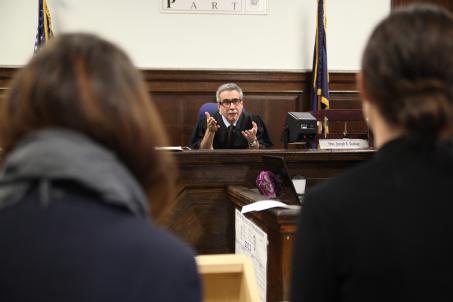
        County (N.Y.) Justice Joseph Gubbay presides over the Brooklyn pilot of the Adolescent Diversion Program.Kings County (N.Y.) Justice Joseph Gubbay presides over the Brooklyn pilot of
the Adolescent Diversion Program.


ROB WOLF: Welcome to New Thinking. I’m Rob Wolf, Director of Communication at the Center for Court
Innovation. Today’s podcasts focuses on a special pilot program called the Adolescent Diversion Program. I’m
in the chambers of Supreme Court Justice Joseph Gubbay, who presides over one of nine sites across New York State
where the adolescent diversion program is being carried out. Glad you could join me on New Thinking today.

JOSEPH GUBBAY: Thank you very much. It’s wonderful
to be here.

ROB WOLF: I think
it would be helpful to start with an overview of what the adolescent diversion program is. So what is it and how
did it come about?

JOSEPH GUBBAY:
Let me give you a little background. New York State and North Carolina are the only two states which prosecute 16-
and 17-year-olds as adults. So Jonathan Lippman, the Chief Judge of the New York court of appeals identified this
inequity and recognized that in order to change it, there would have to be legislative change, which is slow going.
So to address the problem on a more immediate basis, he created these nine pilot programs. What are we trying to
accomplish? Three things. Number one, identify services which, if completed by the individual, will stop the behavior
that brought the individual to court in the first place.

ROB WOLF: And just to be clear, what kinds of charges are you handling in this court?

JOSEPH GUBBAY: We’re seeing actually a whole range
of charges. Certainly we’re seeing theft of services cases, which may involve jumping a turnstile, going into
the subway system without paying the lawful fare. We may see trespass, being in a location without permission or
authority, whether that’s a part after hours, whether that’s a housing development on somebody’s roof
or something like that. But we’re also trying to address the more complex cases, so this may involve assaultive
behavior within a family, assaultive behavior at a school. Goal number two, this is about growth and this is about
maturity, and this is about accountability. For this very, very young population, these are qualities that come with
experience, and these are qualities that come frankly with age. And what we’re trying to do is give this young
population, give these young people the tools to make better decisions, to become more responsible, and three, if
the services are performed as set forth by the court, they will end up without a criminal conviction. These three
goals are shared by myself, the chief judge, and this is the underlying policy of the court. Now none of this could
happen unless you have a progressive prosecutor. And we are very fortunate to have Charles Hynes as the district
attorney of Kings County, who recognizes that this young population really needs to be treated a little differently.
And the services and change and growth are ultimately going to be safer for our community, and a better alternative
than jail. And I think it’s critical to recognize the incredible support that we’re getting from the defense
bar as well. Brooklyn Defender Services, the Legal Aid Society, and the private bar have devoted extraordinary resources
to ensure the success of this program.

ROB
WOLF: In the past, those crimes, those offenses that you’ve described, those all would have been handled in
a more conventional criminal court fashion, as a criminal offense?

JOSEPH GUBBAY: Absolutely. In a typical court, the case may be disposed of with a day or two of
community service cleaning up a park, but we’re trying to something much more than that. We’re trying to
provide a more nuanced approach so a lot of effort goes on in terms of an assessment to identify those specific and
particular needs of the individual that appears before us. That just cannot take place in a large all purpose traditional
court, where the volume of cases is crushing.

ROB WOLF: And I know you work closely with the Redhook Community Justice Center, which has an onsite
clinic and had extensive knowledge of community providers, social service providers, and relationships with them.
How, in fact, have they supported the work of the adolescent diversion program?

JOSEPH GUBBAY: It’s actually a two part model. My job is to identify
services and craft an offer and negotiate between the parties, between the prosecutor and the defense to make a deal
that’s going to work. Compliance is monitored by my colleague, Alex Calabrese.

ROB WOLF: So in essence, the young person comes here, appears before you,
their attorney, the prosecutor, yourself work out the plea, and then they’ll go a couple miles away to the Redhook
Community Justice Center where they might actually have onsite services, they appear before Judge Calabrese, who
monitors compliance, offers his words of encouragement, and they don’t come back here until the case is closed?
Or they never come back unless there’s a problem and they need a little shot in the arm to encourage them?

JOSEPH GUBBAY: Exactly, it’s the latter. Hopefully
then never come back to see me again. If they’re coming back to see me again, it’s because there’s
a problem.

ROB WOLF: I had a
wonderful chance to observe you in the court and I found you were very clear, you didn’t use jargon or lingo,
you seemed to really almost want it to be participatory. You asked people to raise their hand, was this their first
time here, were their family members here? Please raise your hand. You spoke directly to the defendants; you spoke
with their family members when they appeared before you did things like encourage the young person to thank their
guardian, who presumably took time off of work, made an effort to be with them. So there was a certain accessibility
there, and I also thought an attempt to really make sure that the young person understood and wasn’t just a
cog. And I wonder, is this how you always are, or is this a reflection of the fact that a young person, as you’ve
said, that they are in fact different than adults.

JOSEPH GUBBAY: I come to the adolescent diversion part having served in a felony drug treatment
court for many, many years. So I have experience in the area of recovery, in the area of providing services, and
in the area of—I want to call it—engagement. Because there are two models at work here. There’s the coercive
element. If you don’t do it, there’s gonna be a punishment. You have to do it, okay. That doesn’t
always work. There has to be engagement. There has to be internal motivation. So what I’m trying to do is, I’m
trying to communicate and get across that this is going to be something that is going to be good for you and your
family, and those you care about the most. I think it is very, very important, whether in adolescent diversion part,
or whether you’re in a conventional, traditional part, that the process is transparent. And in order for it
to be transparent, then it needs to be intelligible, it needs to be understandable, and it needs to be in a language
that’s gonna be accessible.

ROB
WOLF: So what is it like working with young people, versus your experience working, even with adults in drug court?
And what’s your feeling as the pilot moves forward? You know, has it been successful and what have you learned?

JOSEPH GUBBAY: you know, I’m very, very encouraged.
Our rough sense is that we have a very high compliance rate, somewhere around 80, 85 percent which is extraordinary.
And there needs to be some flexibility, there needs to be second chances, there may even need to be third chances.

ROB WOLF: There are nine pilots that are being carried out in different counties, including here in Kings
County, which is otherwise known as Brooklyn, with the ultimate goal, perhaps, of legislative change so that it’ll
become system wide. And I wonder how you feel about the advantages about testing it in these pilot sites before it
goes system-wide.

JOSEPH GUBBAY: The creation of a pilot program before this goes live if you
will, very sound, very prudent. And it’s exciting to be in the middle of it.

ROB WOLF: Well
it’s been exciting talking to you today. I’m Rob Wolf, Director of Communication at the Center for Court
Innovation and I’ve been speaking with Kings County Supreme Court Justice, Joseph Gubbay, who presides over
the Adolescent Diversion Program here in Brooklyn.

JOSEPH GUBBAY: Rob, thanks for having me.

ROB WOLF: To find out more about the adolescent diversion program or hear more of our podcasts, you can
visit our website at www.courtinnovation.org, or you can listen to us through iTunes. Thanks very much for listening.


Lessons from London: Improving Probation on Both Sides of the Atlantic


While on a visit to observe practices in New York City, Heather Munro, the chief executive of the London Probation
Trust, takes a break to discuss the challenges facing probation in both the U.S. and the United Kingdom and new initiatives,
including experiments in England and Wales with high-intensity community sentence projects (which is also the subject
of a monograph by Centre for Justice Innovation’s director Phil Bowen). November
2012

Judge Joseph Gubbay welcomes observers, including Chief Executive Heather Munro of the London Probation
        Trust, into his courtroom in Brooklyn Criminal Court.Judge Joseph Gubbay welcomes observers, including Chief
Executive Heather Munro of the London Probation Trust, into his courtroom in Brooklyn Criminal Court.


ROB WOLF: Hi, I’m Rob Wolf, Director of Communications at the Center for Court Innovation and today
we’re focusing on probation. I’m with Heather Munro, who’d visiting New York City this week from London.
She was appointed Chief Executive of London Probation Trust in 2010, which means she’s in charge of probation
for the whole city—about 70,000 offenders a year. She’s in New York City this week, learning how probation and
justice in general is carried out in the U.S., observing several of the Center for Court Innovation’s demonstration
projects. Thanks for joining today.

HEATHER MUNRO: Thank you, it’s a pleasure.

ROB WOLF: So probation at its heart is about keeping offenders accountable without sending them to jail
and if things work out well, probation is also about making sure the offender doesn’t return to offending. But
I know in the U.S. that the probation department sometimes has a hard time because of budget cuts, high case loads,
reduced resources. They have a hard time meeting those goals. I understand that in London, you’re going through
an era of change. You’re probably facing quite a few challenges of your own, and I thought maybe we could start
out by you explaining a little bit about what some of those challenges are and how you’ve been addressing them.

HEATHER MUNRO: Okay, yes. Probation in England is slightly different than in New York because we also deal
with offenders who you would normally call on parole. So we’re dealing with both community orders and parole
orders. We call them licensees.

ROB WOLF: So people who have served time in jail or prison and
are returning to the community.

HEATHER MUNRO: Yes. So we have much more of a sort of holistic—we’re
dealing with some very serious offenders, dangerous offenders who are coming out of custody, as well as the lower
level cases. And having observed New York, I think there are lots of similarities about the challenges we’re
facing. You’re right about the economic pressures, having to do more for less is a—we’ve been going through
cuts over the years but there’s also lots of differences. I think we do probably manage to have more contact
with the majority of offenders, although we are about to trial kiosks, which I know is something that’s been
part of the way they’ve managed the large numbers of cases.

ROB WOLF: Here in New York. In
other words, the offender goes to a kiosk and checks in without actually speaking to a human probation officer.

HEATHER MUNRO: Yes, yes. So we’re looking to trial that approach in a different way, I think maybe
as an incentive towards the end of an order or at a different point. So yes, some challenges around how me manage
the cases. What I’ve noticed is that, so the differences are we have probably more use of an assessment tool,
and our staff probably have more intensive training—probably because of the management of these higher risk offenders.
So it takes about 18 months to qualify. So I think it’s slightly different here.

ROB WOLF:
They go through an 18 month training process after they’ve been hired or prior to being hired?

HEATHER
MUNRO: Yeah, well they are hired on the job, so they start off as a probation service officer and then they can be
trained to become a probation officer, and that takes about 18 months on the job and academic, university work as
well. So there’s quite a lot of investment in those people, I think probably because they are managing some
very dangerous and difficult offenders in the community. But otherwise, I think there’s lots of similarities
with New York probation where I think they’re looking at working much more in the community. We are similarly
looking at how can we get our staff much more out of their offices based in the community. So it’s been fascinating
seeing the work that the Center for Court Innovation—all of those, the problem-solving, and how all of that works,
and the real work around community engagement that’s being done. So certainly one of the things we’ll be
taking back is looking at how we can get more buy-in from the community. But also do people really know what we do?
Similar things, I’m sure here, does anybody understand what it is that probation services do? They’ve heard
of us but do they know what we really do?

ROB WOLF: You had actually written an essay where you
said that there isn’t a lot of public understanding, and because of that lack of understanding, there isn’t
a lot of support for community sentences.

HEATHER MUNRO: Yes. Certainly a big thing in the U.K.
around the credibility. And the debate around punishment, and the care aspect, rehabilitation, and there’s been,
over the years, much more of a focus on the punitive elements of order. In fact, only this week there’s been
an announcement from our Ministry of Justice that every community order, probation-type order, will have an element—they
propose to have an element of punishment in there. So we use electronic monitoring, or it could be fines, or it could
be community service, or community payback. So there is a feeling that the public don’t feel that there’s
enough punishment in orders. Now those of us that work in the system probably think that’s not as accurate because
actually doing a community order can, for many offenders, be much more punishing or challenging than going to prison.
They’ve been in and out of prison, it’s very easy, things are on tap, on hand for them. It’s much
more challenging to actually have to change your behavior. So for those of us who’ve tried to lose weight or
stop smoking or whatever, you know, it’s a really difficult process and that’s what we’re often doing
with people is trying to do some difficult work with them about how to change their behavior.

ROB
WOLF: Such as what? Stopping abusing drugs or—

HEATHER MUNRO: Absolutely. Abusing drugs, thinking
differently, domestic violence.

ROB WOLF: And you do have the resources then, because that does
sound—I mean it is called intensive probation. Do you have the resources to be so intensively supervisory?

HEATHER MUNRO: Yes, we do do a lot of the intervention, so there’s a lot of work going into it. So
we run a lot of programs—cognitive behavioral programs, but what we do very much is we base our resources on risk
and need principles. So the higher the risk, and the higher the need, the more resources would go into that, so the
more intensive the work we’re doing. So we also do have people that we’re seeing less often, doing less
intensive work.

ROB WOLF: And then that ties back into your saying that you do an assessment initially,
and that’s how you determine the level of risk and the level of need?

HEATHER MUNRO: Yes.
The assessment is usually done pre-court and it is the basis of all of our work. We call it OASIS and it’s an
assessment system.

ROB WOLF: I noticed you were honorary visiting professor at the University
of Lestor, where you wrote about your interest in research and basing practice on real evidence. And I wondered if
you have been able to incorporate research into the way London Probation conducts business. It sounds like this assessment
tool is an evidence-based practice.

HEATHER MUNRO: Yes it is. I think we’ve found that at
a local level, particularly, it’s been hard to have the resources to do the research that’s needed around
the ways we work. So the one thing we’re doing is trying to build up a greater research capacity within the
trust, but also it’s looking to the evidence that’s done by academic institutions and trying to make sure
our practice is aligned with that. So we’ve done a lot of work around cognitive behavioral groups. We’re
delivering those, but the latest research around assistance theory talks about the importance of the one to one relationships
of offenders being able to see themselves as non-offenders. And so therefore what we’ve done is try to bring
in more peer mentors, more work with people who are ex-offenders so they can see role models there, and try to do
work with our staff around the importance of that one to one relationship.

ROB WOLF: One thing
that I’ve heard about from a colleague of mine, was you were looking at an intensive community order for young gang-involved
individuals. And I know that it builds on the intensive alternative to custody pilots, which our own Phil Bowen,
who directs our London office wrote about—and I’ll link to the paper that he wrote with this podcast, but I
wonder if you can tell me a little bit about why the focus on gang-involved individuals and how that works, how that’s
customized to them.

HEATHER MUNRO: Yes. I mean I think we, first of all, being entrusted in doing
something which is more responsive and different for the younger age group. We deal with people over 18, but the
18-24 year olds, having something that looks different, not that one size fits all approach. When you’re 18
you become an adult and you get the typical adult sentence. And in London the whole problem of gangs is an issue.
It’s a priority for our mayor and the police and for us. So we wanted to help with that, so that’s what
we’re hoping to do, and we’ll start talking to sentences shortly.

ROB WOLF: You started
off a little bit referring to some of the lessons you think you’ll be taking back from New York with you, about
community engagement, for example. Are there any other lessons that come to mind?

HEATHER MUNRO:
Yes. We feel that there’s a lot here around, that’s being done around immediacy, doing things much quicker,
and so we want to look at how we can try and speed up some of the ways in which we are picking people up at court,
working with some very impressive things—like in Brownsville—and others where we’ve seen, where people are seen
quickly and dealt with. So that’s one aspect. I think a more flexible approach, so that it was interesting how
certainly the judge at Red Hook was able to give very flexible sentences.

ROB WOLF: At the Red
Hook Community Justice Center? Judge Calebrese?

HEATHER MUNRO: Yes. And that was great. I really
enjoyed that visit. Also, I think this accountability bit. I think what we’ve seen here is the focus on holding
offenders or clients to account for what they’ve done, and coming back regularly, the reviews, it doesn’t
happen so much. We have some work around that with our drugs courts, but it’s not a routine as I think we could
make it, particularly with the intensive alternative to custody. That’s an option we’ve now thought about
looking at how can we hold people to account at regular intervals.

ROB WOLF: Well great. It sounds
like you’ve had a productive week.

HEATHER MUNRO: We’ve had a great time.

ROB WOLF: I’ve been speaking with Heather Munro, who is visiting New York from London. She is the Chief
Executive of London Probation Trust. I’m Rob Wolf, Director of Communications at the Center for Court Innovation.
Download our podcasts from our website at www.courtinnovation.org and from iTunes. Ms. Munro, thank you so much for
taking the time.

HEATHER MUNRO: Thank you.


Payback with a Purpose


Phil Bowen, co-author of Payback
with a Purpose
 and director of the Centre for Justice Innovation in the U.K.,
discusses what good “community payback” (“community service” in the U.S.) should look like, comparing
the experience in the U.K. with New York City
. The debate about what community payback ought
to be comes at a crucial time for probation services in England and Wales, where the Government is committed
to encouraging non-state organizations to provide community payback.

SARAH
SCHWEIG: Hi, I’m Sarah Schweig of the Center for Court Innovation and today I’m talking with Phil Bowen. Phil Bowen
is the director of the Centre for Justice Innovation in London, and international project of the Center for Court
Innovation that works to promote thoughtful criminal justice reform in the United Kingdom. Phil has just written
a new paper called Payback with a Purpose, about community service, or as it’s called in the U.K., community payback.
And so today he’s here in our New York office and will be discussing some new thinking about giving back to the community
and what it can mean for offenders and communities here in New York and overseas. Thanks for speaking with me today.

PHIL BOWEN: It’s my pleasure.

SARAH SCHWEIG: So just to start off, I think many people
would consider community service or community payback a good thing for the community, but can community payback benefit
both the neighborhood as well as the offenders, and how can it do that?

PHIL BOWEN: Sure. I mean,
I think community payback, when it’s done well, focuses on local issues of concern to a neighborhood, local problems,
whether that be gang graffiti tagging or streets that sort of feel unsafe at night. So payback should be a place
where local law enforcement agencies and local neighborhoods come together to figure out how they can use unpaid
labor to solve problems in their communities. For offenders, it’s about getting them to reflect on what it feels
like to do a good day’s work in that community and put something back on the table for the crime and the harm they’ve
caused. So I think good payback should work at both those levels, looking at how to solve problems for neighborhoods
but helping offenders to move away from a life of crime.

SARAH SCHWEIG: In this paper, Payback
with a Purpose, you mention that the community payback system is sort of at a crossroads in the U.K. Can you speak
a bit about this and maybe what led up to that, and sort of where it is now?

PHIL BOWEN: Sure,
there’s been a government policy since the election of the coalition government 2010 to look at how they can open
up statewide services to other providers, and how that’s kind of played out in the criminal justice field has been
looking at community payback in particular and thinking about, well how can we get other people to provide the service,
rather than it just being provided by the Public Health and Probation Trust. So in July the first big contract was
awarded, it was awarded to a private firm called Circo, who have partnered up with London Probation to deliver community
payback. So it is at a sort of crossroads. You’ve got opportunity where new providers can come in and maybe deliver
it a bit differently, and I guess the theory of change is, can they reduce the costs, reduce recidivism, and provide
something that’s maybe more meaningful to communities.

SARAH SCHWEIG: And I would imagine like
organization of these projects can be very complex logistically and in terms of, you know, the kind of bureaucracies
that are in charge. How do you think, considering that, considering how kind of the delivery on that level can be
kind of complicated and politicized, how do you think community payback practices can ensure that projects remain
or maybe even become more meaningful to the community? Help them be more meaningful based on the sentences that are
being fulfilled?

PHIL BOWEN: Well I guess part of the purpose of writing the paper was to reflect
on, like what’s the really important thing here? The important thing is having payback that works for communities,
that’s engaged with neighborhood associations and civic groups, and that is really driven by local needs. Part of
the point of the paper was to remind people of that because a lot of the discussion in the U.K. has been about contracts
and how the money flows, and who’s getting commissioned. So we have a concern that in that discussion about how payback
will be commissioned, people might lose the picture on what actually really matters to the victims and communities.

SARAH SCHWEIG: So you’ve been listening to some lessons learned from community service practices in New
York City. Can you speak a little about maybe some things that stood out for you, and also how they’ve helped potentially
inform the new thinking about community payback in England?

PHIL BOWEN: I mean in many ways what
the paper’s done is it documents about eight or nine key principles that should be in any good community payback
program. Some of those, in fact most of those won’t be used to practice in England, Wales. I think in many really
good projects that’s what’s happening in England and Wales. What we wanted to do is remind people of those principles
and to make sure that however the new contracts and the new providers come aboard, that has to be the core of what
they do. There’s a great opportunity for building on those principles. They can deliver something that’s even better.
I think one of the things that is striking about the New York practice, which is maybe a bit different than what
we have in England and Wales, is a lot of the Center for Court Innovation projects are based around courthouses.
So there’s a real priority on getting people right after they’ve been sentenced, putting them into an intake office
and set them up for a mandate, and that mandate is worked as quickly as possible. So the sort of idea of swift and
sure justice is one that is actually delivered here. It’s one that I think in England and Wales people embrace and
they get, but whether they’re actually able to deliver it at the moment, I think that’s in question.

SARAH
SCHWEIG: Right, right. There were some—

PHIL BOWEN: Yeah, there’s a sort of classic anecdote that
people would do one day of community services every week and it would stretch on for months and months, and then
it would take two weeks to get them started. No, I think that’s a bit of a myth these days, but I think like all
myths, there’s some truth in it.

SARAH SCHWEIG: The paper does a great job highlighting lessons
from New York and specific cases, and sort of talking about the larger picture too. So, you know, New York and London
are obviously both large urban areas. But I assume that while similar in that way, they also share many differences.
What do you think, in general, are some of the things to keep in mind about applying lessons learned from, you know,
one city to another, or one location to another?

PHIL BOWEN: I think this is a really good question
and something that we’ve struggled with on a daily basis of, you know, looking at particular projects in New York
that are in our field, how do we deliver those in London, or in the U.K. more generally? And I think, you know, one
of the key things to do is to sort of move up a level of instruction and think okay, what are the key ingredients
of making, say, the Redhook Community Justice Center work so well? It’s not necessarily about exactly following a
detailed play book. It’s thinking about, well these guys are really engaging very well with their communities, so
that’s what the core of the values should be, but part of the particularity of communities is understanding that
they’re all different and that you need to respond to those differences. So when we’re advising practitioners about
how to come up with new ideas, we always try to make sure that we’re clear about grounding, the circumstances, the
assets of your community. I mean one key difference, for example, between London and New York is we’ve got a much
bigger state sector. You’ve got National Health Service provides centralized medicine, you know? Those kinds of things,
and they are big things. So you have to always ground whatever you’re trying to do in the circumstances that face
you, rather than try to think that there’s a sort of blueprint that originated in New York and all we have to do
is follow it exactly.

SARAH SCHWEIG: Right. And so just as sort of a take away, since your paper
really addresses this sort of crossroads that’s taking place in the U.K. about public and private services being
utilized, what do you see as some of the potential advantages coming about in the future, from that partnership?

PHIL BOWEN: Well I think one of the takeaways from the New York experience is to, you know, tell a practitioner
in the U.K. that this doesn’t necessarily have to be a scary thing, that it can lead to great renovation, it can
lead to sort of dynamic partnerships with community groups and volunteer sector organizations that maybe you haven’t
worked with before. So it can actually really add value. But it’s about being really clear about what the values
and vision should be, and having that collective vision. And that’s certainly my take away from the New York experience—has
been over 15 years, has been this commitment to a particular vision of payback that’s allowed New York to go from
a position where, frankly, community payback was a bit of a neglected service to something that’s really vibrant
and dynamic. So I guess our message is embrace the change, but embrace the right circumstances.

SARAH
SCHWEIG: That’s great. Thank you so much for speaking with me today. I’m Sarah Schweig and I’ve been speaking with
Phil Bowen at the Center for Justice Innovation in London, about community payback. To find out more about the Center
for Court Innovation or the Centre for Justice Innovation, visit our website at www.courtinnovation.org. Thanks for
listening.